Google translateCookie Policy
Visiting this site
involves cookies!
To find out more please click on Cookie Policy Newsletter & Membership Share this page?STOP PRESS!For the latest articles click on: RSS LoginSearch the SiteMember Profiles |
Friday Facts #3
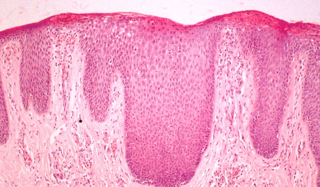
I Normal skin (H&E x46)* The regular cellular architecture of the epidermis (a) provides strength and flexibility. The epidermis is of even thickness, in contrast to that seen in chronic eczema below. II Acute eczema (H&E x46) The regular epidermal layers are interrupted by collections of fluid (b) between the cells, causing structural weakness: scratching and rubbing more easily damages this skin. There are collections of inflammatory cells, which cause redness and itch. III Chronic eczema (H&E x46) The epidermis is greatly thickened in places, with a dense outer cornified layer (c). The varying thickness of the epidermis allows surface penetration where it is thin. The disturbed cellular architecture (d) is due to increased cell division, stimulated by rubbing and scratching.
NB The histological appearance of chronic eczema has been reproduced experimentally by rubbing normal skin with a "scratching machine". When the machine was switched off, the skin recovered. It takes four weeks for the epidemis to replace the disturbed cells with fresh healthy layers again, as in The Combined Approach. This experiment was first carried out over fifty years ago. It led to the introduction of habit reversal as a way of harnessing mother nature in the treatment of atopic eczema.
* H&E = haematoxylin and eosin, the common stains used to study tissues x46 = magnification of the original images, to aid comparison
|
0 Comments Posted Leave a comment